
🚀 The Difference Between Earning $100 From a Job and $100 From Something You Built (And How to Earn Your First $10 On Substack)
From Paychecks to Proof: What My First $10 on Substack Taught Me

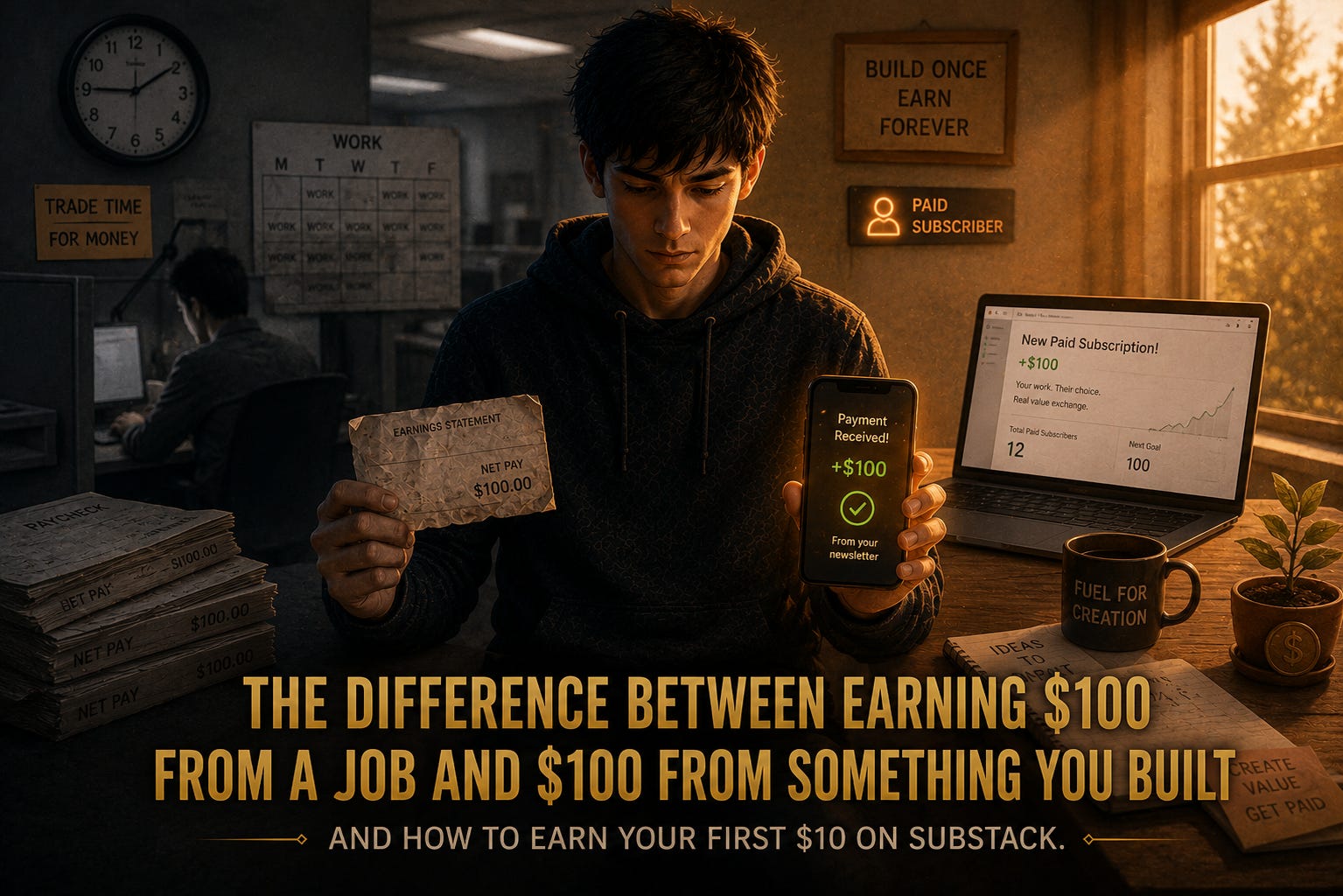
Friend, you know the feeling.
You work. You get paid. You spend. You repeat.
It’s not that you hate your job. It’s not that you’re ungrateful.
It’s just… something is missing.
The money arrives in your account.
You see the number.
But you don’t feel anything.
No excitement. No pride. Just a quiet sense of “okay, that’s done” before you move on to the next bill, the next shift, the next month.
That’s the feeling I had for years.
Every paycheck. Every bonus. Every hour of overtime.
The money was real.
But it didn’t feel like mine.
It felt like compensation. Like a trade. Time for dollars. Life for rent.
Then something changed over the years.
I started building things. Small things.
A newsletter. A daily writing practice. A body of work that people actually read.
And a couple of months ago, I launched the paid version of my Substack.
Nothing fancy. Just a button that said “become a paid subscriber.”
The same day I launched, someone subscribed.
$10. Not $100. Just $10.
But that $10 felt different from any $10 I’d ever earned at my 9–5.
A few days later, another notification. Another $10. Then another.
Today, I’m at around $40 a month from paid subscriptions.
Not life‑changing. Not a full income.
But every time that notification pops up, I feel something I never felt getting a paycheck: I built this. These people chose me. This money came from something I created, not just time I traded.
That’s the difference. Not the amount. The feeling.
Now, let me be honest. I don’t make $100 a day from my business. Not yet.
I make only $40.
But the $100 is just a round number. A stand‑in.
What matters isn’t the exact amount. What matters is the shape of the experience.
The before and after.
The trade versus the creation.
So let me show you what I mean.
Two pictures. Two different lives.
Picture one. The $100 from a job.
It’s a Tuesday afternoon. You’ve been in back‑to‑back meetings since 9 AM.
Your boss asks you to stay late to finish a report.
You don’t want to.
But you need the money. You say yes.
At the end of the week, you get your paycheck.
In that paycheck is $100 that came from those extra hours.
You feel nothing. Maybe a little relief. Mostly just tired.
You spend it on takeout and a subscription you barely use.
That $100 cost you time you’ll never get back.
Energy you needed for yourself.
A small piece of your freedom.
And you didn’t even notice.
Picture two. The $100 from something you built.
It’s a Saturday morning. No alarm.
You wake up slowly. Make coffee. Sit down at your laptop. You open your email.
A notification: someone bought your digital product. $15.
Another: a paid subscriber signed up. $10.
Another: someone booked a coaching call. $75.
You didn’t ask for permission. You didn’t clock in. You didn’t wear pants you don’t like.
You just woke up to $100 that arrived while you were sleeping.
That $100 came from something you made once, a product, a newsletter, a guide, that keeps working for you.
It cost you focus, not hours.
Creativity, not compliance.
And it feels completely different.
Same number. Different universe.
Now let me show you why that difference matters more than the dollars themselves.
🤔 Why Does That Difference Matter More Than The Number
Because the way you earn money shapes the way you live.
When you earn $100 from a job, you’re trading your time. That’s it.
Your attention, your energy, your presence, all rented to someone else’s priorities.
You have no leverage. No ownership.
The second you stop working, the money stops.
That’s not just a financial limitation. It’s a psychological one.
You start to feel like a machine.
Input time, output money.
Your creativity? Not needed.
Your unique perspective? Irrelevant.
Your passion? Leave it at the door.
Over years, that feeling sticks.
You stop asking what you want to build, what you care about, what you’d do if money weren’t the question.
You just optimize for the next paycheck.
Now flip it.
When you earn $100 from something you built, you’re not trading time.
You’re trading value.
You solved a problem once, and it keeps helping people.
You wrote something true, and it keeps resonating.
You built something useful, and it keeps working while you sleep.
That money feels different because it comes from you, not from a boss, not from a system, not from showing up when you’d rather be anywhere else.
It’s proof that your thinking matters.
That your effort compounds.
That you can create something that outlasts your hours.
And that feeling? It changes how you see yourself. You stop feeling like a resource. You start feeling like a creator.
That’s why the difference matters.
Because how you earn $100 determines who you become. Not because $100 is a lot.
Now let me break down the specific differences you’ll feel in your own life.
🆚 The Real Differences (Not Just the Dollars)
Let me walk you through the real differences, the ones you feel in your body, not just on a spreadsheet.
First, control.
When you earn $100 from a job, someone else decides when you work, where you work, and how much you get paid.
You can negotiate. You can advocate.
But at the end of the day, the boss holds the lever. You don’t.
When you earn $100 from something you built, you decide everything.
The price. The offer. The hours. The direction.
If you want to raise your prices, you do it.
If you want to take a week off, you take it.
No permission. No approval. Just you and your choices.
That control changes how you move through the world.
You stop asking “can I?” and start asking “what’s next?”
Second, leverage.
Job money is linear.
You work one hour, you get one hour’s pay.
To earn more, you have to work more, climb higher, or stay longer.
There’s a ceiling. And you hit it fast.
Built money is exponential.
You create a digital product once, and it can sell 100 times.
You write a newsletter once, and it keeps attracting paid subscribers.
You record a video once, and it keeps finding new eyes.
Your effort compounds. Your income isn’t capped by your hours.
That leverage is the difference between feeling stuck and feeling like you’re finally moving somewhere.
Third, fulfillment.
This one is harder to measure, but you feel it instantly.
Job money often comes with a quiet resentment.
You didn’t want to stay late.
You didn’t want to fake enthusiasm.
You didn’t want to pretend that report mattered.
But you did it anyway.
And the money felt like compensation for that small betrayal of yourself.
Built money comes with a quiet pride.
Someone chose your work.
Someone trusted you.
Someone found value in something you created from nothing.
That feeling doesn’t fade. It fuels you to build more.
Fourth, identity.
Job money says: “You are an employee. You are replaceable. You are a cog.”
Built money says: “You are a creator. You are irreplaceable. You are the source.”
One shrinks you. The other grows you.
When you see yourself as a creator, you stop waiting for permission.
You start trusting your own judgment because you've already proven you can build something real.
Over time, that identity shift changes everything about how you show up, what you attempt, and what you believe is possible.
💵 Can a Side Income Really Become Something Bigger
Every business starts small. Microscopic. Embarrassingly small.
The first $100 becomes $500. Then $1,000. Then $5,000.
Every large income stream you’ve ever seen began with a tiny first payment, often one that made the creator laugh at its smallness.
Think about it.
The first person who ever bought a book from an unknown author paid what? $10? $15?
That author didn’t stop.
They wrote another book. Then another. Then a course. Then a community.
The first person who subscribed to a now‑famous newsletter paid $5 a month.
The creator didn’t look at that $5 and think “I’ve made it.”
They thought “someone trusted me.” And they kept showing up.
Here’s the math that changed how I see small income: if you earn $10 this month from something you built, you now have proof.
Proof that your idea has value. Proof that strangers will pay you. Proof that the model works.
Next month, you aim for $20. Then $50. Then $100.
It compounds.
Why? Because you stay in the game long enough for the small amounts to stack and grow.
Your first $100 won’t change your life. But it will change your mind.
And that’s where real growth starts.
🧠 What Changed In My Mind After Earning My First Money Online
Let me be honest with you.
When I started on Substack, I was determined.
My mindset had already shifted. I felt ready.
But despite all that, a quiet doubt still lived in the back of my head.
Can I really, really make money from my writing alone?
I knew you could make money from videos. Everyone knows YouTube pays creators.
I knew you could make money from selling things, affiliate marketing, courses.
But a newsletter? Who on earth would pay to read? People don’t read anymore. Attention spans are gone. The algorithms reward video, not text.
I had never seen anyone make real money from writing. Not up close. Not in a way that felt possible for me.
That doubt could never have been answered without taking the experiment.
No amount of thinking, planning, or reading would have told me the answer.
I had to do it.
So I wrote. Every day. For four months.
Then I launched the paid version. And the answer came.
Yes.
People subscribed.
Not thousands. But enough.
Enough to prove that writing is just another form of providing value, for people who want real depth and real transformation.
Not everyone reads. But the ones who do? They’re willing to pay for words that change how they see themselves.
Now, let me clarify something. This wasn’t my first dollar online.
Eight years ago, in my first year of the 9–5, I made a course.
A random experiment.
Just to see if I could make money from a course.
And I did.
But it didn’t feel like mine.
It was a test. A curiosity. Not a business.
This time is different.
Substack is the first real business I’ve ever started.
The first dollars from your real thing hit different.
Here’s what changed after my first paid subscriber:
I realized money is literally everywhere.
If you can do something well, you can get paid for it.
The only barrier is the work you put in before you see the first result.
Most people quit before it shows up.
For me, on Substack, that upfront work was four months. Four months of writing every single day and posting NOTES and engaging.
For someone else, in a different niche, it might be eight months.
For another, two months.
It depends. But what is sure is that the result will come. No matter how long it takes.
And now? I’m not scared anymore. I understand how to earn money.
If tomorrow I were homeless and needed to find money, I know how to do it.
That knowledge gave me a confidence I never had before, confidence to navigate my life, to take risks, to trust myself.
That’s what earning your first real dollars does.
It doesn’t just put money in your account. It rewires your brain from scarcity to possibility.
I started feeling less trapped.
I began seeing opportunities everywhere.
I realized that money can come from solving problems instead of clocking in.
I understood that income can be created, not just traded for time.
📚 What Did Earning My First $40 Teach Me About Money?
More than any book, course, or seminar ever did.
Because $40 from my Substack wasn’t theory. It was proof. And proof rewires you differently than information.
Here’s what I learned.
Money follows value. Not hours. Not effort. Not suffering. Just value. Those $40 came from people who read my free articles, felt something shift inside them, and decided that feeling was worth $10 a month. I didn’t convince them. My writing convinced them. The value did the work.
People pay for solutions. Not features. Not promises. Not fancy branding. My subscribers don’t pay because I have a beautiful logo. They pay because I help them feel less alone, less stuck, less confused about money, corporate life and business. That’s the solution. And they value it enough to pay for it.
Skills create income. I didn’t have a degree in writing. I didn’t have a certificate in marketing. I just practiced every day until I got less bad. That skill, writing words that make people feel seen, turned into $40. Then more. The same will happen for you with whatever skill you decide to build.
The internet creates opportunities. Thirty years ago, earning money from writing meant getting published in a magazine or newspaper. Good luck. Today, I can write from my couch, hit publish, and someone on the other side of the world can pay me within seconds. That’s not normal. That’s magic. And most people sleep on it.
You don’t need permission to earn. No boss approved my newsletter. No committee reviewed my paid subscription. No gatekeeper decided I was worthy. I just built it. Put it out there. And people decided for themselves. That’s the most liberating lesson of all: in the digital economy, you are the permission slip.
My first $40 didn’t make me rich. But it made me free in a way a paycheck never could.
❌ What Mistakes Delayed My First $40?
Let me save you months of wandering.
My first $40 from Substack took four months of daily writing. But that’s not where the delays happened.
The real delays happened before I even started Substack.
In the years before.
The years I spent jumping between platforms, learning instead of building, waiting for perfection, and comparing myself to everyone else.
Here are the mistakes that cost me years, not months.
Learning instead of building. I watched courses, read threads, saved templates. I felt productive. But I wasn’t producing. Knowledge without output is just expensive entertainment. The $40 didn’t come from knowing more. It came from writing, publishing, and letting people respond.
Switching strategies. I’d try a headline style for three days. Nothing. So I’d change it. Then my posting time. Then my hook.
The $40 arrived only after I picked one approach and stayed for weeks.
Waiting for perfection. I wanted every video to be flawless. Every digital product to be complete. Every tweet to be clever. So I’d re-edit the same video three times. Or I’d delay launching a product because it wasn’t “ready.” Or I’d rewrite a thread for hours. Nothing ever felt good enough. The $40 came only after I stopped waiting for perfect and started publishing messy, honest work.
Trying to help everyone. I thought my YouTube channel had to appeal to everyone. My digital products had to solve every problem. My Twitter audience had to be massive. So I made generic content that pleased no one. The $40 came when I finally wrote for one person: someone tired of the 9–5, confused about money, wanting to build something real. Everyone else could leave. That focus, on one person, one problem, worked.
Fear of selling. I was embarrassed to ask for money. I thought if my writing was good enough, people would magically pay. They won’t. The $40 came when I finally clicked “launch paid version” and let people decide. Most didn’t buy. A few did. That’s how it works.
Constant comparison. I watched other writers gain hundreds of subscribers overnight. I felt behind. I wanted to quit. What I didn’t see was their years of work before that moment. Comparing my month three to their year five kept me stuck.
Don’t make these mistakes. Or do, and lose months like I did.
The shortcut isn’t a secret hack. It’s avoiding the traps I fell into.
💡How To Earn Your First $10 From Something You Built
Forget the idea of building a “business” for a second. That’s too big. Too abstract.
You don’t need a brand, a funnel, or a perfect product.
Right now, you need one thing: proof that someone will pay you.
Not followers. Not likes. Not validation.
Money.
Here’s how you get it.
👉 Step 1: Choose a problem you’ve actually lived through
Don’t pick a niche.
Don’t pick what’s trending.
Pick a frustration you’ve dealt with recently and can explain clearly.
Not:
“I want to teach productivity”
But:
“I couldn’t stay consistent after work, so I built a 15-minute system that actually worked”
Specific problems attract specific people. Specific people pay.
If you’re unsure, look at your last 30 days:
What frustrated you repeatedly?
What did you figure out the hard way?
What do people ask you about?
That’s your starting point.
Not passion. Not market research.
Lived experience.
👉 Step 2: Turn that problem into a simple, usable result
People don’t want information. They want a shift.
So don’t create “content.” Create a path.
Bad:
“A guide on discipline”
Better:
“How to sit down and work for 15 minutes after a draining day (without relying on motivation)”
Now make it practical:
Step-by-step
Clear constraints
No fluff
Think:
“If someone follows this tonight, will something change?”
If the answer is no, it’s not ready.
👉 Step 3: Treat your newsletter like the product, not the marketing
This is where most people get it wrong.
They think:
“I’ll post content, grow an audience, then monetize later”
No.
Your writing is the product from day one.
Write 5–10 posts around the same problem. Not random ideas. One theme. One struggle. One transformation.
Example:
If your topic is “losing weight while working a 9–5,” your posts could be:
Why you feel too tired to work out after work (and what to do instead)
The 20-minute workout rule that actually fits a busy schedule
How to lose weight without counting every calorie
What to do on days when you have zero motivation to train
Why you keep restarting your diet (and how to finally stay consistent)
Each post should feel like a piece of a system.
At the end of each one, don’t beg. Don’t over-explain.
Just say:
“If this helps, I go deeper in the paid version.”
That’s enough.
👉 Step 4: Make the price real, even if it’s small
Set $5 or $10.
Not because it’s a lot. But because it changes behavior.
Free readers skim. Paid readers pay attention.
And more importantly, you change.
The moment you charge, you stop hiding behind “I’m just sharing.”
Now you’re solving a problem for real people.
That pressure is good. It forces clarity.
👉 Step 5: Lock yourself into a 30-day execution window
This is where almost everyone fails.
They post 3 times.
No results.
They change everything.
New topic. New style. New platform.
That’s how you stay stuck.
So make a rule:
Same problem. Same voice. Same format. 30 days.
No changes.
Even if it feels repetitive.
Even if no one responds.
Even if you think it’s not working.
Because what feels repetitive to you is consistency to the reader.
And consistency builds trust. Trust leads to the first sale.
👉 Step 6: Measure output, not reaction
You are not allowed to judge results early.
Your only metrics:
Did I publish today?
Did I solve one problem clearly?
Did I make this simpler than yesterday?
That’s it.
Not:
subscriber count
likes
comments
Those are delayed.
Most people quit because they measure the wrong thing too early.
You won’t.
👉 Step 7: Expect the first sale to feel small but hit hard
It might take 2 weeks.
It might take 2 months.
But when it comes, it won’t feel like money.
It will feel like confirmation.
Someone you don’t know read your words and decided:
“This is worth paying for”
That moment matters more than the amount.
Because now you know:
You can do it again.
And again.
And again.
That’s how it starts.
Not with $1,000.
With $10 that proves you’re no longer just consuming.
You’re creating.
🔚 Final Thoughts
So here’s the truth most people avoid:
The difference between earning from a job and earning from something you built isn’t about money.
It’s about ownership.
One path teaches you to trade your time and wait for permission.
The other teaches you to create, to think, to solve problems, and to get paid for it.
Your first $10 won’t change your life.
But it will change how you see what’s possible.
It will show you that you don’t have to rely on a system that takes your time, your energy, and your attention.
It will prove that you can build something of your own.
And once you see that, you can’t ignore it.
But here’s where most people stop.
They understand the idea.
They feel the shift.
Then they go back to guessing.
Trying random things. Starting and stopping. Switching strategies before anything has time to work.
That’s exactly why I built the full version of this newsletter.
Every week, I send you more than thoughts.
I send you the actual tools I use to design income alone.
No partner. No team. No noise.
Paid subscribers get:
→ The exact framework I use to find time when I have none (even with a job, responsibilities, and zero energy)
→ A step-by-step guide to building an audience from scratch, what to post, what to say, and how to talk so people actually listen
→ How to create digital products that sell (not just “content”, real offers people pay for)
→ The sales and pricing strategies I learned through failure (so you don’t lose months guessing)
→ Templates to track your progress, test ideas, and stay sane when results feel slow
→ Exercises that unstick you when you’re confused, bored, or ready to quit
→ An honest week-to-week account of what building a one-person business actually looks like, not the highlight reel
→ Personal recommendations from my actual setup (tools, resources, and systems that changed how I think about money and online business)
No prior knowledge needed. No partner required. No team required.
Just one person who figured it out alone, writing so you don’t have to take five years like I did.
If this article made you pause and question things you’ve always accepted…
This is where it becomes practical.
Full access is $10 a month.
That’s less than two coffees.
But it might be the difference between staying in a system that takes from you…
And building something that finally gives back.
You can cancel anytime. No friction.
But if you stay, you get the tools to build something that’s yours.
Not your boss’s.
Not your family’s.
Not society’s.
Yours.
I love your honesty
No eye watering figures, just great advice and guidance.
Delighted to be one of your tribe.
The distinction between trading time and trading value is the whole thing. A paycheck compensates you for hours. A subscription or a product compensates you for a solution you built once that keeps working. That difference is not just financial. It rewires how you see yourself.
The part that stopped me was about the first $10 being proof, not profit. Most people quit before they get that proof because they measure by the amount instead of the signal. The signal says someone trusted you. That is worth more than the dollar amount.
I am still early in my own Substack journey. 4 paid subscribers. 78 total. Some days it feels like nothing. Then a notification comes in from someone I have never met who decided my words were worth paying for. That feeling is not about the money. It is about the confirmation that the work landed.
Thank you for this. It is easy to get lost in the numbers. You reminded me what the numbers actually stand for.